
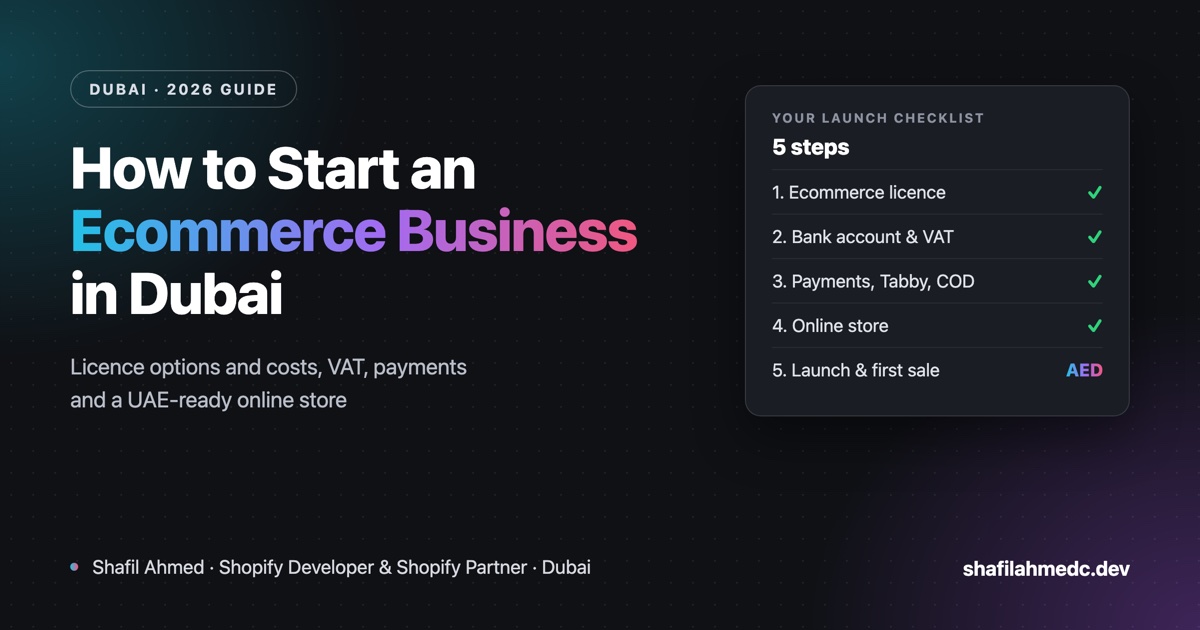
To start an ecommerce business in Dubai, you need three things: a licence that allows ecommerce, a way to take payments, and an online store that works for UAE shoppers. The cheapest legal start is a Dubai eTrader licence at about AED 1,370 a year; most growing brands choose a free zone or mainland company instead. I build online stores for UAE brands as an ecommerce developer in Dubai, and this is the order I recommend to every new founder.
Fees below are from 2026 business setup guides, not official price lists. Licence fees change often, so confirm the current amount with the authority before you pay.
Step 1: Choose your ecommerce licence
You have three main options. The right one depends on who you are, what you sell and whether you need visas.
Option 1: eTrader licence (cheapest, for individuals)
- Issued by: Dubai Department of Economy and Tourism (DET).
- Cost: about AED 1,370 a year (around AED 1,070 for the licence plus AED 300 Dubai Chamber membership), according to 2026 guides.
- Who it's for: one person running a home-based online business. No partners, no office needed.
- Limits: the activities expat residents can register are more limited than for UAE and GCC nationals, and it doesn't come with residence visas. Check what your activity allows on the DET website before applying.
- Good for: testing an idea, handmade products, small social-media shops.
Option 2: Free zone company (most popular for online stores)
- Cost: published digital or ecommerce packages start at roughly AED 5,750 a year in lower-cost free zones, and from about AED 12,500 in Dubai zones such as Meydan. Larger Dubai zones cost more.
- Dubai CommerCity is the UAE's dedicated ecommerce free zone, with warehousing and logistics on site. It doesn't publish prices; quotes are on request and usually higher.
- Good for: most online brands. You get a company, a corporate bank account and visas (for an extra fee).
- Check: some free zone licences limit how you sell to mainland UAE customers, so ask the zone how its ecommerce activity covers online sales across the UAE.
Option 3: Mainland company (DET)
- Cost: estimates for the licence start around AED 12,000 to 25,000 in the first year, plus an office lease (Ejari) and visas.
- Good for: brands that also want a physical shop, a warehouse in Dubai, or government and large corporate clients.
My rule of thumb: start with eTrader if you're testing alone and eligible, choose a free zone if you're building a real brand, and go mainland only when you need a physical presence.
Step 2: Open a bank account and register for VAT when needed
- Open a business bank account in the company's name. You'll need it for payment payouts.
- VAT: a UAE business must register when taxable sales pass AED 375,000 in 12 months, or are expected to pass it in the next 30 days. You can register voluntarily from AED 187,500. The rate is 5%. Registration is done on the Federal Tax Authority's EmaraTax portal.
- Even before you register, set your store prices so adding 5% VAT later doesn't break your margins.
Step 3: Set up payments UAE shoppers expect
UAE customers pay in more ways than most new founders plan for:
- Cards and Apple Pay through Shopify Payments or a local gateway.
- Buy now, pay later: Tabby and Tamara are expected in fashion, electronics and beauty. See Tabby vs Tamara vs Postpay on Shopify.
- Cash on delivery (COD): still common in the UAE. Plan to confirm COD orders on WhatsApp to cut refusals.
Payment providers ask for your trade licence, ID and bank details, so do this after Step 1 and 2.
Step 4: Build your online store
This is where most of your sales depend on getting the details right. For most new businesses I recommend Shopify: it handles hosting, security and checkout, and your team can run it without a developer. See Shopify pricing in the UAE for current plans in AED.
What a UAE-ready store needs:
- AED pricing and VAT set correctly.
- Delivery rules per emirate, delivery times on product pages and a courier integration.
- English and Arabic, with a proper right-to-left layout if your customers read Arabic.
- Fast mobile pages. Most UAE shoppers buy on their phone. When I tested 11 UAE Shopify stores this month, mobile speed scores ranged from just 13 to 74, mostly because of extra apps and scripts.
- Trust signals: clear returns policy, real contact details, WhatsApp support and reviews.
- Basic SEO from day one: product titles, descriptions and collection pages written for what people search.
Later, a mobile shopping app connected to the same store can bring repeat customers back. See Shopify mobile app development.
Step 5: Launch, then plan around the UAE sales calendar
- Soft launch to friends and social followers first, and test a real order with every payment method.
- Plan your first campaigns around the big UAE dates: Ramadan and Eid, UAE National Day (2 December), White Friday and the Dubai Shopping Festival.
- Set up abandoned cart emails or WhatsApp messages before you spend on ads.
A simple first-year budget checklist
- Licence and registration (eTrader, free zone or mainland).
- Visas, if you need them.
- Shopify plan and paid apps.
- Store design and development.
- Payment fees (cards, Tabby / Tamara, COD handling).
- Delivery and packaging.
- Marketing: ads, content and influencers.
Want your store built while you sort the licence?
You don't have to wait. I can design and build your store on a development store while your licence is being issued, then connect payments and launch as soon as it's ready. Tell me what you sell on WhatsApp and I'll send a plan and a fixed quote, or see ecommerce website development in Dubai.
Licence fees checked against 2026 business setup guides and VAT rules against the Federal Tax Authority in November 2026. Fees change often, so confirm with DET or your chosen free zone before applying. This guide is general information, not legal or tax advice.
Frequently Asked Questions
Yes. Selling online in Dubai needs a licence that includes an ecommerce activity, from the Dubai Department of Economy and Tourism (mainland) or a free zone. Selling without one can lead to fines, and payment providers will ask for your licence before they activate payments.
The eTrader licence from the Dubai Department of Economy and Tourism is the cheapest, at about AED 1,370 a year including Dubai Chamber membership, according to 2026 business setup guides. It is for individuals running a home-based online business, and the activities expat residents can choose are more limited than for UAE and GCC nationals, so check eligibility with DET first.
Published 2026 packages for digital or ecommerce activities start at roughly AED 5,750 a year in lower-cost free zones and from about AED 12,500 in Dubai zones such as Meydan. Zones with warehousing, such as Dubai CommerCity, quote on request and are usually higher. Visas, office space and bank accounts are extra.
A UAE business must register for VAT when its taxable sales pass AED 375,000 in 12 months, or are expected to pass it in the next 30 days. Voluntary registration is possible from AED 187,500. The VAT rate is 5%.
For most new stores, Shopify is the simplest choice: it handles hosting, security and checkout, supports AED, Arabic, Tabby, Tamara and cash on delivery, and your team can run it without a developer.