
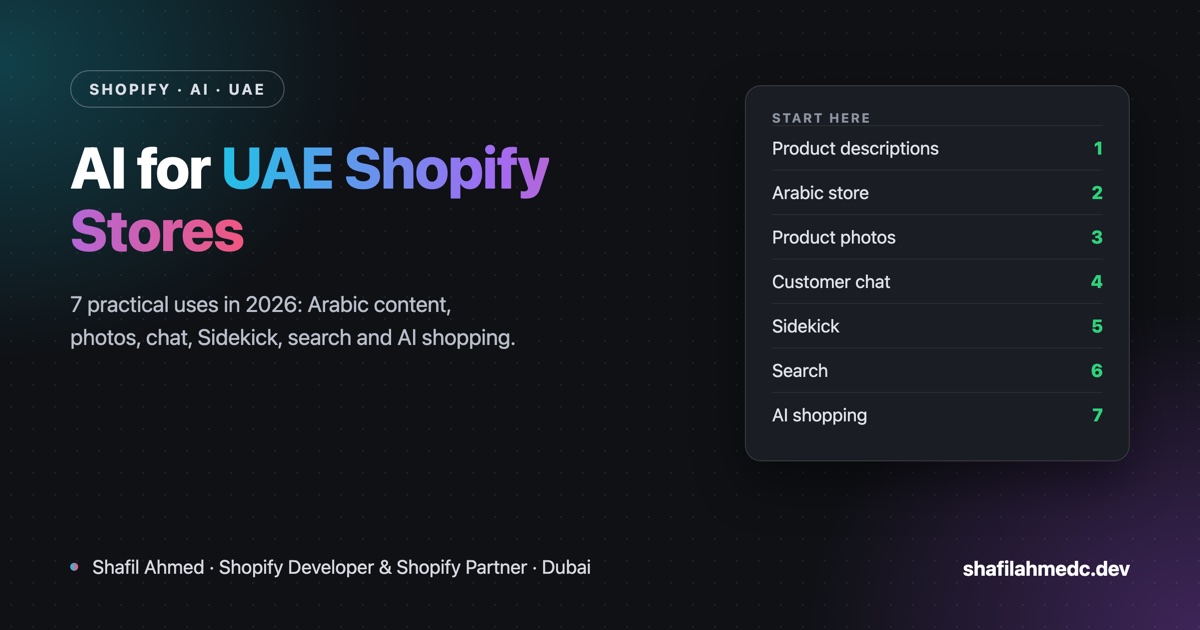
AI won't run your Shopify store for you, but in 2026 it can take hours of work off your week. Shopify now has AI built into the admin, most of it at no extra cost, and a few tools matter a lot for UAE stores in particular: Arabic content, product photos, and answering the same delivery and cash-on-delivery questions every day.
Here are the seven uses I'd set up first on a UAE Shopify store, in order. If you want help with any of them, see my AI automation services in the UAE.
My honest view before we start: most stores should start with product content and Arabic, not with a chatbot. A chatbot that answers badly in Arabic costs you more trust than it saves time.
1. Product descriptions in less time
Shopify can generate text for product descriptions, pages, blog posts and emails from inside the admin. It's useful for stores with hundreds of products and thin descriptions copied from suppliers.
How to get good results:
- Give it facts, not just a name. Material, sizes, fit, what's in the box, care instructions, delivery time in the UAE. AI fills gaps with guesses if you don't.
- Set your tone once. For example: "short sentences, no exaggeration, mention free delivery in Dubai over AED 200".
- Use Sidekick for whole collections. Sidekick can plan changes across a collection, such as rewriting every description in it, and apply them after you approve.
- Check every fact before publishing. Shopify itself warns that AI output can contain errors. A wrong size or material means returns.
2. An Arabic version of your store
For stores selling to Saudi Arabia and much of the GCC, Arabic isn't optional. Two recent changes make it easier on Shopify:
- AI translations. The Translate & Adapt app translates your store content automatically, and can keep translations up to date as you edit the English version.
- Better right-to-left support. Shopify has improved support for Arabic, Hebrew and Urdu across storefronts, checkout, customer accounts and its Horizon family of themes. Older or custom themes may still need RTL fixes.
Machine translation is a starting point, not the finished job. Have a native speaker review your homepage, top 20 products, size guide, shipping and return policies. My guide to building an Arabic Shopify store properly covers the full process, including Arabic SEO.
3. Cleaner product photos
The Shopify file editor can remove an image background, replace it with a colour, or change an image from a text prompt. Shopify also has a free mobile app, Tinker, with AI tools for images and video.
Good uses: white backgrounds for marketplace-style listings, consistent backgrounds across a collection, and lifestyle-style banners for a sale.
One rule: your main product image should show the real product. If an AI-edited photo changes the colour, size or texture, you'll pay for it in returns and refused COD orders.
4. Answering customers faster
Shopify Inbox has an AI agent, instant answer suggestions and suggested replies. Shopify's storefront agent can now recommend products, start checkout in the chat and hand over to your staff.
In the UAE, most customer questions are the same five: delivery time, cash on delivery, returns, sizes and "where is my order?". Before you switch on any AI chat:
- Write clear answers to those five questions on your site, in English and Arabic.
- Test the AI agent with real customer questions, in both languages.
- Make sure there's always a way to reach a person.
Many UAE customers prefer WhatsApp to website chat. Answering on WhatsApp with AI usually needs a separate WhatsApp Business API setup. My WhatsApp COD confirmation guide shows one way to start.
5. Sidekick for the boring admin work
Sidekick is the AI assistant in your Shopify admin. In 2026 it can do much more than answer questions. According to Shopify's Fall '26 Edition, it can plan multi-step changes, edit draft orders, help build checkout customizations, explain payouts and chargebacks, and build Shopify Flow automations.
Questions worth asking it this week:
- "Compare sales and average order value from White Friday week with the same week last month."
- "Which products have the most returns in the last 90 days?"
- "Create a Flow that tags cash-on-delivery orders over AED 500 for a phone call before shipping."
- "List products with no description or fewer than 3 images."
Always review what Sidekick stages before you approve it. For ready-made workflows, see 10 Shopify Flow workflows for UAE stores.
6. Search that understands your shoppers
Shopify has improved predictive search, which suggests products while shoppers type. On a bilingual store, search still needs some help from you:
- Add synonyms in the Search & Discovery app, so "abaya" and "عباية", or "perfume" and "oud", find the same products.
- Check what people search in your Shopify reports. Searches with no results tell you what to stock or how to rename products.
- Set up filters for size, colour and price on your main collections.
Good on-site search matters more than it seems. A shopper who searches is usually ready to buy.
7. Being found in AI shopping
More shoppers now ask ChatGPT, Gemini or Google's AI Mode what to buy. Shopify is connecting stores to these channels through Shopify Catalog. Its Fall '26 Edition lists selling in Google AI Mode and Gemini with Shopify checkout, an eligibility check for Shopify Catalog, and a page to review the business details AI agents share about your store.
What to do now:
- Check your Shopify Catalog eligibility in the admin and fix what it lists.
- Complete your product data: titles that say what the product is, full descriptions, correct categories, prices and stock.
- Review your policies and FAQs, because AI agents repeat them to shoppers.
Availability can differ by country, so check what your admin shows for the UAE.
Where built-in AI stops
Shopify's AI covers a lot, but UAE stores often need things it doesn't do out of the box:
- An AI assistant on WhatsApp that answers in Arabic and English and checks order status.
- Daily reports combining Shopify, ads and courier data.
- Syncing orders with Odoo or your accounting system.
- A custom Shopify app for a process that's specific to your business.
That's where tools like n8n and custom apps come in. My guide to 7 n8n automations for UAE Shopify stores shows practical examples, and I build custom Shopify apps in Dubai when no app fits.
Where to start this week
- Ask Sidekick for products with missing descriptions or images, and fix your top 20 sellers.
- If you sell to Saudi Arabia, publish Arabic and have the key pages reviewed.
- Write clear delivery, COD and returns answers before any chatbot.
Not sure which of these would help your store most? Ask for a free Shopify store check and I'll send you your top 3 fixes.
Frequently Asked Questions
Most of Shopify's built-in AI tools, including Sidekick and text generation for product descriptions, are included at no additional cost. Shopify says availability can vary by plan, device and language, so check what appears in your own admin.
Shopify's AI translations can translate your store into Arabic through the Translate & Adapt app, and Shopify has improved right-to-left support for Arabic storefronts, checkout and its Horizon themes. Have a native Arabic speaker review your homepage, best-selling products and policies before you publish.
Sidekick is the AI assistant built into the Shopify admin. You can ask it questions about your store data, have it draft content, build Shopify Flow automations, edit draft orders and plan several changes at once, which you review and approve before they're applied.
Only after the basics are done. Most UAE customers ask about delivery times, cash on delivery and returns, often on WhatsApp. Make those answers clear on your site first, then add AI chat that can answer them in English and Arabic and hand over to a person.
Shopify is connecting stores to AI shopping channels such as ChatGPT, Google AI Mode and Gemini through Shopify Catalog. Check your eligibility in the admin, keep product data complete and accurate, and review the business details that AI agents share about your store.